CASE 7; Employee engagement
What is employee engagement? It does not mean, happiness nor
satisfaction of employee. Quiet often people mix-up these terms, and real
meaning behind the engagement of employee. Employees might be happy at work and
they might be very satisfied with their workplace, but it does not mean that
they are working hard and productively putting maximum effort to each task they
are doing.
Difference between satisfied and engaged employee can be
subtle(table1);
Satisfied employee
|
Engaged employee
|
||
Feels
|
Behaves
|
Feels
|
Behaves
|
Pleasant
|
No stress
|
Passionate / energised
|
Helps colleagues
|
Content
|
Low absenteeism
|
Involved / committed
|
Makes good quality
|
Grateful
|
Low turnover
|
Trusting
|
Takes initiative
|
Customer-oriented
|
|||
Goes beyond expectations
|
|||
Table 1- Satisfaction ≠ Engagement
As we can see from table above, we can define those
employees into engaged and non-engaged employees. Besides these two types of
employees there is third type of employee, actively disengaged. It is kind of
employee that are not just unhappy but they are publicly expressing ther unhappiness
and un-engagement. This kind of employees are to bring bad atmosphere into
workplace making engaged employees to be demotivated.
So, what is causing disengagement of employee? Bad management,
not listening to your employees, working with non-engaged manager, not giving
employees chance to talk and reflect their skills in their work. Engagement of
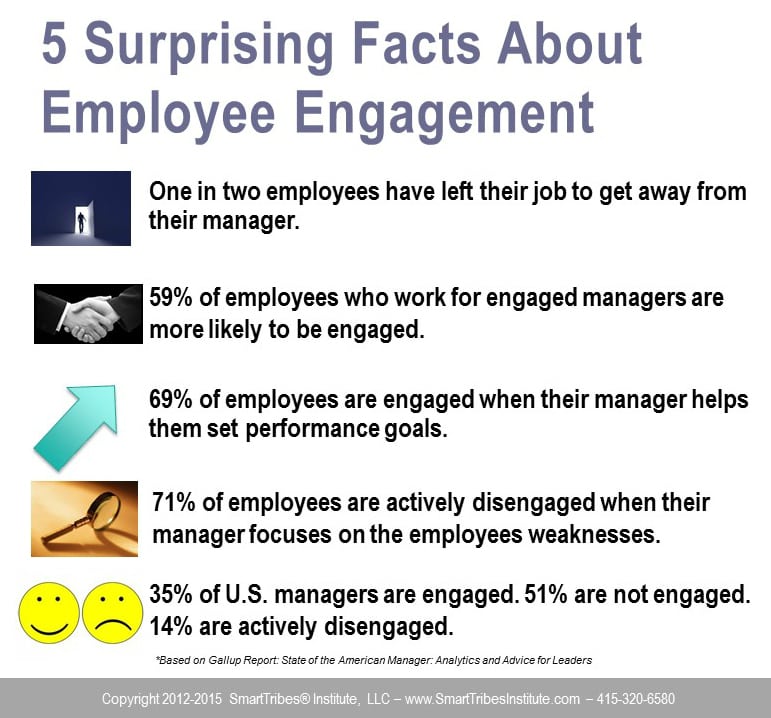
employee start from engaged manager. According to research conducted by SmartTribes
Institute;
-
One in two employees have left their job to get
away from their manager
-
59% of employees who work for engaged managers
are more likely to be engaged
-
69% of employees are engaged when their manager
helps them set performance goals
-
71% of employees are actively disengaged when
their manager focuses on the employees weaknesses
-
35% of U.S. managers are engaged, 51 % are not
engaged and 14% are actively disengaged
To activate employee engagement, one need to start from
managerial roles. Company need to engage managers, to convey engagement to
employees. Also when employees are encouraged, praised and their colleagues are
committed to quality work, will it engage them even more. Managers need to know
their employees, listen to them and learn about them. Simply by calling them by
first name is already engaging them in one way. When setting goals for
employees, company and managers should not leave them to their own fortune, but
to provide job trainings to help them. Part of the training them is job
shadowing, and allowing them to take special and interested projects to improve
their skills
Sources;
Gomez, Balkin & Cardy 2016, Chapter 4. Managing Human
Resources, 8 th edition, Pearson.
Employment Today, Engagement makes all the difference.
Forbes, Employee engagement what and why, 2012.
URL; https://www.forbes.com/sites/kevinkruse/2012/06/22/employee-engagement-what-and-why/#1f98292e7f37 accessed; 02.05.2017
SmartTribe Institute, 5 surprising facts about employee engagement.
URL; http://smarttribesinstitute.com/wp-content/uploads/5-Surprising-Facts-About-Employee-Engagement-Graphic.jpg accessed;02.05.2017

Ei kommentteja:
Lähetä kommentti