torstai 4. toukokuuta 2017

CASE 10

Case 10

Wells Fargo;

September 2016, was a time when media started to reveal ”dark” secret of Wells Fargo; Apparently employees of the bank had created over 2 million fake accounts. Result of this, Wells Fargo fired 5300 employees because of the illegal activity they were practising for over the last two years. Wells Fargo also agreed to pay a historical high fine of 185 Million Dollars.

Employees of Wells Fargo claim that they have been pushed to do illegal actions, and mentioned that the managers checked in for 4 times a day, asking if they have reached their sales goal. This claim has even caused a lawsuit against Wells Fargo back in May 2015.

When opening bank accounts, the employees created wrong e-mail addresses, like 1234@wellsfargo.com, so that they could confirm the opening of a new bank account by themselces. Many of them have opened bank accounts even for their friends and family, either with or without their knowledge. (Egan 2016, 1-3)

Few days after this case became public, the head of Wells Fargo, Mr. Stumpf, resigned (BBC 2016, 1).

Because of these illegal activities done by their employees Wells Fargo has promised to change some things;

-       They will send a confirmation Email to the customer within one hour, when a new bank account opens on the same name.
-       They will contact every single deposit customer in the USA to see if they really wanted the bank account on their name or not.
-       They will contact thousands of credit card customers to ask the same thing. BBC 2016, 1-2

But who’s fault is it? It is always easy to pin point with a frowning finger to the CEO only for those issues, but is it really his fault? Of course, CEO of Wells Fargo, Mr. Stumpf should have known about those practices. The creation of 2 million bank account is not something a CEO does not hear about, and as it is known and stated, some people even called the ethics hotline to tell about the ongoing problem, more than once. What makes it scandal, is that those employees got fired afterwards. (Egan 2016, 1-2

But let us first see this from different point of view; The official reason for the termination of those persons were never because they called the ethics hotline.  Of course, Wells Fargo couldn’t just say that, but what iif it is true and those employees got fired for valid reason and the CEO really did not know about this? What could the bank do then to bring justice to the customers whose identity got stolen? They could fire the employees who did illegal actions – and that is exactly what Wells Fargo did.

But no matter who is to blame, it still is a fact that the HR department did a very bad job. The HR department should have taken every complaint seriously, and it should have never discharged any employees because of calling the ethics hotline. Wrongful discharging of an employee can cause a lot of trouble for the company and may cause even a lawsuit.

Also we have learned in previous case 7 that setting too high goals for the employees is a bad thing to do. Wells Fargo is a perfect example of what happens if the goals are set too high. This should teach lesson to every HR Department in any company, anywhere in the world.

Sources

BBC 2016, 1-2. Wells Fargo boss urged to resign over accounts scandal.
URL: http://www.bbc.com/news/business-37419968
Accessed on the 09.05.2017

BBC 2016, 1. Wells Fargo boss John Stumpf steps down.
URL: http://www.bbc.com/news/business-37639648
Accessed on the 09.05.2017

Egan, M. 2016, 1-3. Workers tell Wells Fargo horror stories.
URL: http://money.cnn.com/2016/09/09/investing/wells-fargo- phony-accounts- culture/index.html
Accessed on the 09.05.2017

Egan, M. 2016, 1-2. I called the Wells Fargo ethics hotline and was fired.
URL: http://money.cnn.com/2016/09/21/investing/wells-fargo- fired-workers- retaliation-fake-
accounts/index.html

Accessed on the 09.05.2017

CASE 9

Case 9;

The Challenges for the HR department;

The biggest challenges the HR department faces can be put into two groups; Environmental challenges and organizational challenges.

Quick change is biggest challenge. This means that the environment, in which the company operates, changes quickly. This affects almost all industries and can cause a large amount of stress for the employees which can, in extreme cases, even lead to homicide and suicide at work. Also, the Bureaou of Labor statistics reported that 50% if the Americans working at home say that they are not being compensated for that time. This is not happening only in USA but also in Asia. As an example, employee of Foxconn in China who jumped to his death and employee of Dentsun in Japan who commited suicide It was found out that employee of Dentsun was doing over 100 hours’ extra work every month leading her to her death.  (Gomez, Balkin & Cardy 2016)

The all mighty Internet is yet another challenge for HR department, because there is no boundaries there and it brings information about everything to everyone in a matter of seconds. This means that each customer can not only check the reviews of the products, but also compare the prices as well. And if the company do something unethical, like when Zara let child refugees in Turkey work in their factories (BBC 2016), the whole world can know about in a matter of seconds.

Workforce diversity is yet another big challenge. How can the company arrange it so that all cultures get along with each other, so that no one is discriminated and that the company does not have to face a discrimination lawsuits? The Globalization, which is also a challenge, may increase the workforce diversity and thereby the problems.

The organizational challenges are often a by-product from the environmental challenfes. Those are for example downsizing of the company, decentraöization, technology, data security and outsourcing, which goes hand in hand with globalization. Challenges can also be seen from an individual perspective. How can the HR-Department find the right people? How can they be enpowered and how can their productivity be increase? That’s why every company should create and implement a HR strategy.

The benefit of HR-strategy when the company have put some effort into it;
-       Identify gaps between current situation and future visions
-       Encourage proactive behaviour
-       Identify HR constraints and opportunities
-       Clearly communicate company goals
-       Comply with the 10 principles of the UN Global Impact (UN 2017)

Creating such a strategy is no easy task either. How can company make sure that they maintain the competitive advantage they may have due to their unique strategy? How can strategy manage with the environment= we see that creating the is not easy at all.

As a ground rule, the strategy should fit with the environment, the organizational strategies, the organizational characteristics, and the organizational capabilities. If the strategy fits with all og these, then it should improve the company’s performance by many folds.


Sources:

Gomez, Balkin & Cardy 2016, 23-63. Managing Human Resources, 8 th edition, Pearson.

UN 2017, 4. Global Impact 2017 Toolbox.
URL: https://www.unglobalcompact.org/docs/about_the_gc/UNGC-2017- toolbox.pdf
Accessed on the 07.05.2017

BBC 2016, 1-2. Child refugees in Turkey making clothes for UK shops.
 URL: http://www.bbc.com/news/business-37716463
 Accessed on the 07.05.2017

CASE 8

CASE 8

Employee Separation

Employee separation is a moment when an employee stops working at a company. As there can be many reasons for employee separation, and it is not only bad for employee but for the company as well. Employee will lose his incomes, and company have to find and train new employee which is not that cheap.

Very firstly, we need to define the turnover rate. Turnover rate calculated by taking the number of employees divided by the average number of employees during the period, and times twelve divided by the numbers of months in the period.

We must not forget the fact that there is the voluntary terminations as well as involuntary terminations. Both of them can be put in the either the category external or internal, marking the place where the decision for the termination came from. An external, voluntary terminatin would be a quit, and an internal involuntary termination would be a mandatory transfer.

As mentioned, the costs of termination are severe. The costs consist of:

- Recruitment costs. Finding and recruiting a new employee forces the company to invest in marketing and recruiting.

- Selection and training costs force the company to select the right employee –
and that costs money in the form of salaries who search and select the right people. Training costs can be immense, depending on the job that needs to be occupied.

- Separation costs have to be faced in the form of exit interviews and outplacement assistance. (Gomez, Balking & Cardy 2016).

Employee termination does not only have disadvantages but advantages as well. Advantages includes for example reduced labour costs, in case new employee has a lower salary, or no new employee is needed at all. When Nokia relocated jobs to Romania, they saved money by paying lower wages (YLE 2011).

Other advantages are for example the replacement of poor performers, increased innovation and the opportunity for better diversity in company.

But before a company decides to lay off employees, they should consider alternatives to layoffs. Such an option could be for example employment policies, which can include a hiring freeze, and providing early retirement packets to those in age.

In case company still decided on a layoff, it should notify employees fairly in time. Also, the layoff criteria’s should be discussed and developed  in advance, and the communication with the laid-off employees should be kept active as well, to ensure that everything goes well. The last thing the company should do is extremely important; Reassuring the position of employees still with the company.

Sources:

YLE 2011, 1-2. Nokia cuts 3500 jobs “to ensure profitability”.
URL:http://yle.fi/uutiset/osasto/news/nokia_cuts_3500_jobs_to_ensure_profitability/5431070
Accessed on the 05.05.2017


Gomez, Balkin & Cardy 2016, 204-225. Managing Human Resources, 8 th edition, Pearson.

tiistai 2. toukokuuta 2017

CASE 7

CASE 7; Employee engagement

What is employee engagement? It does not mean, happiness nor satisfaction of employee. Quiet often people mix-up these terms, and real meaning behind the engagement of employee. Employees might be happy at work and they might be very satisfied with their workplace, but it does not mean that they are working hard and productively putting maximum effort to each task they are doing.

Difference between satisfied and engaged employee can be subtle(table1);

Satisfied employee
Engaged employee
Feels
Behaves
Feels
Behaves
Pleasant
No stress
Passionate / energised
Helps colleagues
Content
Low absenteeism
Involved / committed
Makes good quality
Grateful
Low turnover
Trusting
Takes initiative


Customer-oriented


Goes beyond expectations
Table 1- Satisfaction ≠ Engagement


As we can see from table above, we can define those employees into engaged and non-engaged employees. Besides these two types of employees there is third type of employee, actively disengaged. It is kind of employee that are not just unhappy but they are publicly expressing ther unhappiness and un-engagement. This kind of employees are to bring bad atmosphere into workplace making engaged employees to be demotivated.


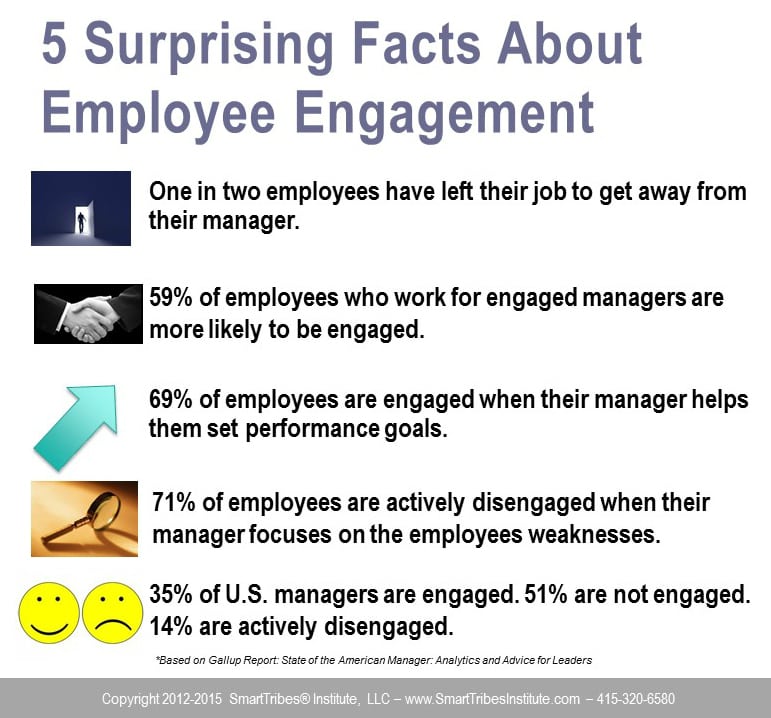
So, what is causing disengagement of employee? Bad management, not listening to your employees, working with non-engaged manager, not giving employees chance to talk and reflect their skills in their work. Engagement of employee start from engaged manager. According to research conducted by SmartTribes Institute;
-       One in two employees have left their job to get away from their manager
-       59% of employees who work for engaged managers are more likely to be engaged
-       69% of employees are engaged when their manager helps them set performance goals
-       71% of employees are actively disengaged when their manager focuses on the employees weaknesses
-       35% of U.S. managers are engaged, 51 % are not engaged and 14% are actively disengaged

To activate employee engagement, one need to start from managerial roles. Company need to engage managers, to convey engagement to employees. Also when employees are encouraged, praised and their colleagues are committed to quality work, will it engage them even more. Managers need to know their employees, listen to them and learn about them. Simply by calling them by first name is already engaging them in one way. When setting goals for employees, company and managers should not leave them to their own fortune, but to provide job trainings to help them. Part of the training them is job shadowing, and allowing them to take special and interested projects to improve their skills


Sources;

Gomez, Balkin & Cardy 2016, Chapter 4. Managing Human Resources, 8 th edition, Pearson.

Employment Today, Engagement makes all the difference.

Forbes, Employee engagement what and why, 2012.
URL; https://www.forbes.com/sites/kevinkruse/2012/06/22/employee-engagement-what-and-why/#1f98292e7f37 accessed; 02.05.2017

SmartTribe Institute, 5 surprising facts about employee engagement.